Pages

Thursday, June 29, 2017

Nokia is back!!!

I'm not going to fanboy out too much, but here's my history with Nokia in brief:

N800 frontside1.jpg
The Nokia N800

The N800 was my first Nokia device, I bought it second-hand on craigslist so I had something I could take to coffee shops or the library and use free wifi to check my emails and catch up on news. We're talking 2008, I had a laptop but it wasn't fun to take out with me. It was a great device, very handy.  I'd had a PDA before, but the N800 was something different, with an open platform and a bunch of free user-created apps.  The touch-keyboard wasn't responsive enough to write long emails or anything, but it opened my eyes to how productive small devices could in the future---we were almost there.

It had two full SD card slots!  I wish I could find a mobile device with two micro-sd slots today.

Nokia N900.JPG
The Nokia N900

The N900, well, let's face it, it wasn't much to look at.  But it was packed with interesting features.  Reflective-pixeled screen so it was usable in direct sunlight, slide out keyboard, USB host mode (might have needed a third party patch?), IR blaster, FM transmitter.  A little slider button which was great for unlocking the device, no pocket dialing on this thing.

Oh, and it ran what to this day is still the best mobile OS I've ever used, Maemo 5.  The multitasking is still far superior to what Android has today, not that Android's anything to sneeze at.  It had the same type of open philosophy to software and the same marketplace to download and install free user apps.

I loved this phone.  Seriously.  I still have it.

Anyway, the N900 didn't sell well.  It wasn't even officially supported by any carriers in the US, though it was compatible with T-Mobile's bands (that's who I used it with).  There was no advertising, nobody really knew about it.  I never saw a N900 in the wild besides my own.  Not even in any stores.  I don't know what Nokia were thinking, maybe they had good reasons, who knows?

BTW, Maemo 5 was based on Debian Linux, and it was pretty easy to install desktop Linux apps onto the N900.  Just another big pro, especially for nerds.

Nokia started cranking out some beautiful looking phones, but none that pushed all my buttons.  I still love the tapered design of the N8, but I wasn't interested in Symbian3, the operating system on it. I think the N8 was used by son-of-Flynn in the newer Tron movie. Maemo 5 became MeeGo, which I think got released on the N9, but I don't remember that device being too impressive otherwise.

I had my eye on the N950, pictured below.  This is one of the issues of following tech sites that hunt out leaked pictures and specs.  The N950 was just a developers device and was never properly released to the public as far as I know.
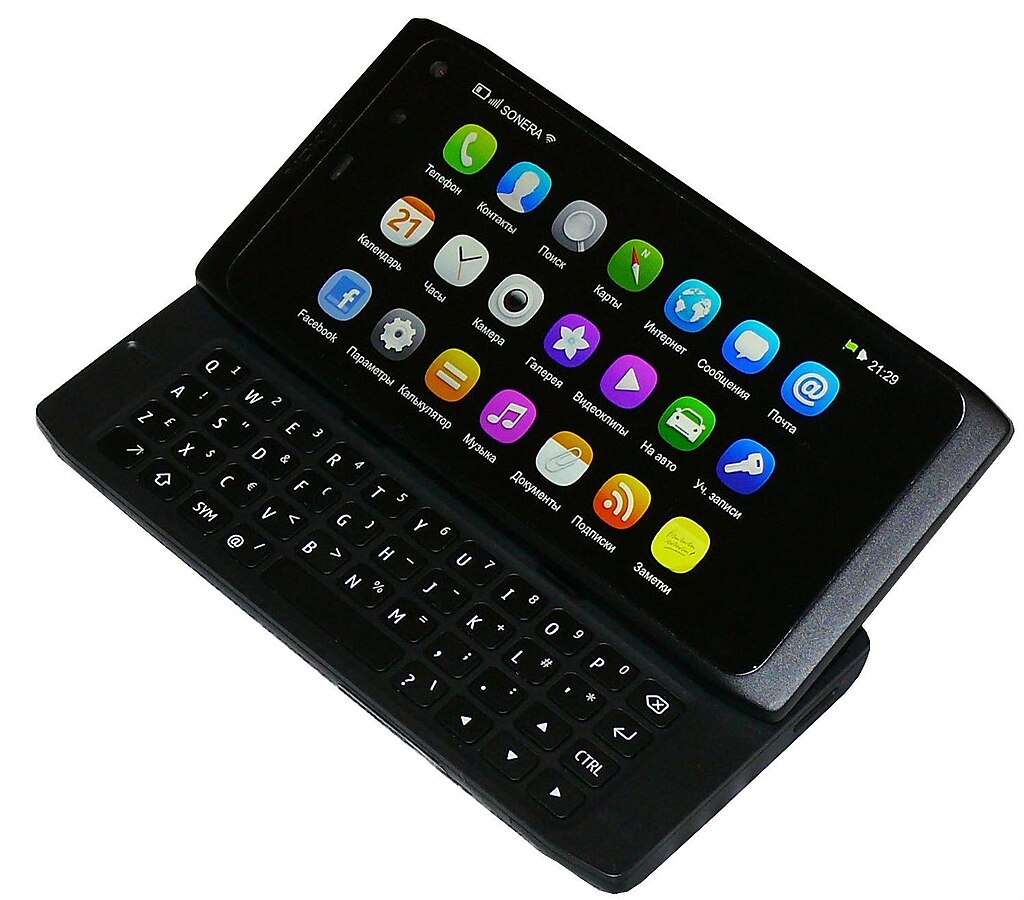
Nokia N950.jpg
The Nokia N950, only released as a developer device.
That's too bad, because it's freaking gorgeous.  I don't care how big the bezels are, I love that design.

Anyway, Nokia brought on an ex-Microsoft executive as CEO, and as every Nokia fan in the world feared, it was a trojan horse maneuver to negotiate the sale of Nokia to Microsoft.  I don't think I can fault Microsoft, Nokia must have wanted it to happen.  Their handset sales were declining.

Then Windows phones came out with the Nokia logo, and then Microsoft sold the Nokia name to some Chinese company.  And press releases say there are ex-Nokia executives working for the new Nokia.  I can't find out who they are or what their history with Nokia was.

Anyway, they've released a few standard Android smartphones, "standard" meaning there's no crazy features (FM transmitter) or anything.  They're getting good reviews, there's one Youtube video scratching the shit out of the Nokia 6 with a razor blade and talking about how good the build quality is:

He has another video where he takes the Nokia 6 apart and says it's on track to be one of the most durable phones (perhaps the most durable) of 2016.  Whoever's running the company, I'm glad they're not dragging the name Nokia through the dirt.

The new execs have said they're going to stick with stock Android and not worry about new software.  That's probably a good idea, Nokia tried to get traction with their music and map apps, and it didn't seem to work.  I mean, I wish Maemo 5 would make a comeback, but Android's okay.

The Nokia 6 is around $230, the US version can be pre-ordered on Amazon.  There's going to be a Nokia 9 announced, a flagship phone (probably $700) that I'm looking forward to.

I'm worried that the Android smartphone market is too flooded for them to make traction by just releasing solid, affordable phones.  I hope I'm wrong.  I plan to buy the 6 as a backup phone/music player when the US version comes out.  It would be nice to see them come out with a slider phone or something more techy like the N900 was, but I'm happy with the phones they just released.  I mean, they tried the N900 once already, right?

Til then,

David

Wednesday, June 28, 2017

This is surprisingly messed up (SSL error)


I just fired up my trusty Android tablet and got a few strange errors---apps I didn't launch were popping up and taking over my screen to tell me there was no connection to the internet. This is behavior I haven't seen from them before, even when Wifi is turned off. When I got these errors my Wifi was connected, and I was connected to the same network on my phone and it was loading web pages just fine. From my tablet I was even able to connect to my local file server via Wifi without issue.

I open up Firefox and am told that Google.com is an untrusted source, or something to that effect.  Every site is.  What the hell is going on here?

I search for the problem on my phone and find a simple solution:  The date was set wrong.

My tablet had died a few days ago and must have really, really drained the battery, as the date was reset back to 01/01/2012.  Yeah.

As soon as I corrected the date, then everything came back up.  Everything.  Hangouts messages, other apps notifications.  Online banking info.  Emails.  Google Play update notifications.

I guess I had been getting new error behavior because there was a connection, the software just couldn't verify that it was secure.  Strange that the apps couldn't have a better error message saying the SSL was invalid, but that's how it goes.

I'm happy my tablet is working fine again, but I keep thinking about what went wrong.  You're telling me all it takes to severely break someone's internet connection is to set their date back?

I'm also wondering, does network time (which automatically updates electronic devices) also go through SSL?  If you changed the time enough to break SSL would that keep it from righting itself?

Hmm.  Seems pretty iffy to me,

David

Monday, May 30, 2016

Autohotkeys and Firefox

Apparently there is a problem for some people (myself included) where Autohotkey (AHK) scripts aren't working in Firefox.  I have a "master" AHK script which does many things, for instance it keeps my middle mouse button from opening multiple copies of a tab from a single click, and it also remaps the "Capslock" key to act like the "Backspace" key (saves my right pinky some stress while touch typing).

I found a few mentions of it in message boards, but no solutions, besides reverting to an older version of Firefox.

I'm running Firefox version 46.0.1 and Windows 10, and I solved this problem by running the script as an Administrator.  I had that option available in the right click menu.  If you don't, or want something more permanent than right-clicking each time to launch the script, compiling it to an exe file and then setting it to always run as Administrator (under "Properties", then go to the "Compatibility" tab) also worked for me.  I'll launch the script directly, because I'm always tweaking and adding to it.

I'd be curious to see if running Firefox in Windows 7 compatibility mode would also work.

(Hmm, I also just checked and Firefox's shortcut was set up to always run as Administrator, not sure if that's default or something I did when troubleshooting something else.  Worth checking, for anybody out there with the same problem.  I don't want to close Firefox and restart out of Admin mode right now to test it but it's reasonable to assume that could be causing the issue.)

FYI,

David

Tuesday, March 29, 2016

A review of Google's voice typing feature

It was yesterday when I first saw that Google Docs now has a voice typing feature. After doing some research, I saw that the feature which had been available since September, apparently. I've been playing with it for multiple hours now, and this is what I think.

Monday, March 28, 2016

Universal Comments Reborn

I was recently talking to a friend of mine about an old Google tool which let users comment on any website---not in that website's comment section, but in a superimposed sidebar which allows commenting on any page, even (and especially) ones which don't allow embedded comments. It was called Sidewiki.  There's a demo of it embedded below:


It was launched in 2009 and scrapped in 2011.  Why was it scrapped?  I'm not sure, and the announcement was made along with the shutdown of other Google services.  There was a lot of public concern over it while it was live.  Jeff Jarvis wrote while it was active:
Google is trying to take interactivity away from the source and centralize it. This isn’t like Disqus, which enables me to add comment functionality on my blog. It takes comments away from my blog and puts them on Google. That sets up Google in channel conflict vs me. It robs my site of much of its value (if the real conversation about WWGD? had occurred on Google instead of at Buzzmachine, how does that help me?). On a practical level, only people who use the Google Toolbar will see the comments left using it and so it bifurcates the conversation and puts some of it behind a hedge. Ethically, this is like other services that tried to frame a source’s content or that tried to add advertising to a site via a browser (see the evil Gator, which lost its fight vs publishers).
His issue seems to have been that Google was crossing a line as far as the types of service it was providing.  I understand his POV but I'm not sure that I agree with the assertion that most conversation about your blog taking place somewhere else robs it of any value.  Danny Sullivan wrote an extremely in-depth look at the plugin, if you're curious.  Andy Beal chimed in to say he wasn't scared.

While none of these articles seem to be worried about bullying or misuse per se, I do remember some posts at the time worried that it could be used for harassment or trolling purposes.  And it seems that is still the pressing worry around existing universal comment systems.

Imagine that you're the kind of shitposter who spends hours flooding a web site with vitriol, only to be blocked from interacting on that site.  What next?  Well, you could take to twitter, or reddit.  You could create your own blog to talk shit on the site that blocked you.  With Sidewiki, you could continue posting your vitriol right there, adjacent to the very page that blocked you.

Back to the start of this post, I telling my friend I found it strange that another universal commenting tool hasn't established itself, especially with so many blogs and even major news sites disabling comments site-wide.  I'm writing this post now because I just saw an article about a new tool performing such a task.  The tool is called "Genius" (and actually in researching Genius I've found a few more trying to gain popularity as well.  I won't be discussing those here).

I couldn't find an official video showcasing Genius. They have at least two youtube channels dedicated to severe autofellatio, but no overviews I could find which showed the tool in action.  Here's a video of someone using the tool to annotate poetry.


It was this Ella Dawson article which brought Genius to my attention:
Opening my post using Genius was like discovering graffiti over some of my most personal work. Annotations display more like passive aggressive Post-It notes, but for someone who has been gaslit by partners, diminished by journalists, and harassed by mobs online, Genius annotations are an invasive violation. The design itself doesn’t help in this regard. I expect line edits from my actual editor, a thesis advisor, or even a friend sharing their thoughts on an early draft; I have no established relationship of trust and respect with the denizens of the internet.
Is this a good idea?  I don't know.  First I have to tamp down the statement: "for someone who has been gaslit by partners, diminished by journalists, and harassed by mobs online, Genius annotations are an invasive violation."  You could say the same thing about (irl) bulletin boards, online message boards, text messages, critical reviews, phone calls and both snail and electronic mail.  You could say that about literally any informational or communicative progress, because anything which makes people's lives easier tends to raise all boats---making both good and bad actions easier.

Debating whether such a service is good or bad is probably a silly waste of time, unless such a debate is followed by a discussion on how to minimize any identified harm.  My gut feeling is that this is just one of those things that will keep being attempted until it finds success, either in a small service most people aren't aware of, because maybe it didn't have legs after all, or by spreading like wildfire across the internet.  Just like the MPAA/RIAA could stop Napster but not bittorrent, bloggers can maybe slow down or stop a few forms of universal commenting but can they kill them all?  This is an idea with too much potential, too easy to immediately grasp for it not to keep pushing itself up through various forms until one finally sticks.  That's not to say it's destined to get huge, but I'd guess it'll be sticking around in some form indefinitely.

I feel similarly about those people review services (such as Peeple) that are floated every now and then, generally resulting in them being beaten down by the scorn of the internet.  While scary to many, the idea is also greatly appealing to others and it appears reasonably straightforward to implement.  On the internet that means you're not going to be able to stop it.  I don't necessarily like the idea, because history has shown anybody can be made to look like a bad person in any situation, even if they were being entirely moral.  Especially on the internet.

(And let's be honest, it's rarely as simple as being "good people" or "bad people".  The vast majority of us think we are good, but some of us have decided as the situation escalates around us that our interests would be better or more easily served if we stopped acting politely or in good faith. There are some people who readily conclude that their circumstances, no matter how dire or benign, entitles them to abandon politeness or good faith.  These people may have a tendency to ruin things for everybody else, and I would bet there are always people worse off who somehow manage to be kinder and better behaved, but that's the closest I think I would ever get to defining someone as a "bad person" or a "good person".)

It is worth pointing out that Sidewiki and Genius are two different implementations of a similar idea.  Genius, originally Rap Genius, was designed to annotate rap lyrics, then poetry and literature, and now web sites.  One of the comments of Ella Dawson's article notes that Genius seems to scrape content and host it on its own site, where as Sidewiki was just a sidebar that served comments from elsewhere.  I'm curious if that distinction could get Genius into some DMCA trouble.

And returning to the question of this being this a good or a bad thing, it occurs to me that it's probably a little of both.  Like most new online services, people seem to gravitate between either rolling their eyes or proclaiming the world forever changed.  Remember how people reacted to Twitter?  It hasn't changed the world much, but it certainly has changed the internet, at least a little bit.  The truth is Genius sounds like it would be catnip to most shitposters, which means that any average person checking it out, if it gains any traction, could be inundated by shitposts and as a result take anything read there with a grain of salt.

Thinking about another site that attracts shitposters, Reddit, we see that by providing a large variety of community-moderated gardens Reddit generally succeeds in keeping the shitposters in their own designated spaces.  I don't know how such a model would apply to Genius, and I can't imagine that it will be easy to discourage the abuse of such a potentially spiteful megaphone, short of implementing constant site-wide moderation.  And indeed some of the comments Ella Dawson found offensive were posted directly by an employee of News Genius.

Another lesson, which occurred to me only after I was making a cursory proofreading pass over this article, is this:  If we accept that people being hugely opposed to something like Genius or Peeple will have little effect on its success or failure, then surely we can imagine a world where products like Peeple or Genius have very little effect on a person or website's success.  At best they will be services which allow us to cut through noise to find better information, at worst they will contribute through the noise and only be patronized by the people who enjoy that particular type of noise.

We'll find out someday.  Til then,

David

Thursday, January 21, 2016

Wireless Xbox One Controller on Windows 7

FYI for any Googlers out there.  I recently bought the wireless dongle for the Xbox One controller (I was using a microUSB cord, but it started to get a bit touchy).  It didn't work at first on Windows 7.  I got the adapter to be recognized by manually installing a driver, but the controller wasn't recognized. The problem appeared to be that I had Windows Update turned off, therefore didn't get the drivers I needed, even though I downloaded and installed the official drivers individually.

Microsoft was very little help.  They don't link directly to driver files anymore, they direct you to their download site (which requires Internet Explorer, ugh) and tell you what to search term to use to find the files.  Really Microsoft?  A bit rinky-dink isn't it?  Also the bulk of their advice was for the Xbox One or Windows 10.

Saturday, October 3, 2015

Rant time

I decided it would be nice if my last post on Google Drive was published rant-free.  It might be the first time I've ever mentioned Google in a post without an accompanying rant.  Nah, once upon a time I was pretty enamored with them.  I still am, mostly.

And this rant isn't even about Google, it's about smart quotes.

Smart quotes are the default in Google Docs.  They convert your "dumb" quotes into "smart" ones.  You can turn them off.  When writing, I don't like smart quotes.  They cause problems when going from one format to another (like when pasting text into an email), and they're completely redundant.  I have never, ever, ever, ever, ever seen a single use of quotation marks in which it was not obvious to me whether a particular mark was opening or closing a quotation.

Redundancy is good.  Most of grammar is about redundancy.  All the really important bits, anyway.  Tenses, plural forms, if you know something is incorrect when seeing it in print, then that's the same as saying the broken rule is redundant---or else how could you know how it was wrong?  But humans have comprehension and attention problems, so we really want a lot of redundancy into our language.  (Another example of good redundancy:  the comedic pause, which gives everybody a chance to catch up and be ready for the punchline.  And, if it's a good setup, it builds anticipation too.  The pause isn't needed in order to send the information of the joke, it merely enhances its reception).

However, I don't think smart quotes' redundancy actually helps anything.  If there ever were a strange custom case, like if you wanted to break the mold and do nested quotes, smart quotes are largely automatic in most software, so they still would hinder instead of helping you.

While looking for an argument for smart quotes, I found this web site, Smart Quotes For Smart People, with the goal of telling you that you should be using smart quotes.  They also link to tools which can help people use them more easily.  It's a cool site and they're not being dicks about their grammatical fashion like some people.

We can pretend in typography (and all design) that there's an objective right and wrong, but there are a lot of things that are simply a matter of taste.  There's a lot of deliberate misinformation out there to help "experts" pretend like subjective things are objective, or to pretend like the true purpose of a consensus (even a fabricated one) is to bully people into doing things a particular way.  Smart Quotes for Smart People aren't doing any of that.  But they also don't give you any reason (that I saw) as to why you should use smart quotes, besides simply saying that you should.  They do have pictures of smart quotes and dumb quotes side by side, around phrases.  Perhaps they think the aesthetic superiority of their position will be universally self-evident and not require an explanation?  Well guess what?  I admit it, the smart quotes do look better.

In fact, there's a tool I use in epub creation that changes three hypens (---) into an em-dash (—).  I use that a lot.  That same function also turns dumb quotes into smart ones.  I can't turn it off, it does them both at the same time.  I used to resent that.  As of this moment, I just became cool with it.

So rant nullified.  I still don't think they're necessary 90% of the time.  I'm not going to do crazy shortcuts to generate them, I'll let my publishing pipeline handle that.  But when fixing text into a permanent, public-facing design or document, yeah, I'll go with smart quotes.

Til then,

David

Google Docs Revisited

So I'm finally at a place with a draft after I've made a round of content edits and pasted it into Drive's document editor to check out it's proofreading suggestions.  Check this out:
She smiled, and brushed some loose stands of hair away from her face.
The editor caught "stands" in there, and suggested "strands".  That's amazing.  Stands is a real word, right?  Yet by context it somehow knew it was wrong.  I'm assuming it's informed by the contextual engine they built for voice recognition?

On the other hand, to test whether is was something as stupid as "stands" not being in their dictionary, I typed this:
As you may or may not know, Fibberhta is not a word.  Blogger knows that, it just told me so.  I typed "Drianks" and put in a sentence to see if maybe the editor hadn't caught up yet, but it was underlined as incorrect immediately.  To further test, I put Fibbherta in a proper sentence:
So it seems that it needs some context to evaluate a word.  Note I made that expanded sentence so it could be presumed that Fibberhta was a proper noun, perhaps someone's strange name, but Docs did still flag it.  What does Google suggest instead of Fibberhta?  Why "Fibber Hta", of course.

Not perfect, certainly useful and incredibly impressive.  If Blogger used this proofreading engine, my blog posts would be way cleaner.

Anyway, just an FYI.

David

Friday, September 11, 2015

Proofreading (and mini-rants) on Google Docs

tl;dr - Google Drive seems to have a pretty good grammar proofreader, possibly good enough to justify pasting drafts in regularly for a quick analysis.

***

So I don't really like Google Drive for many reasons.  Mostly because I've tried to use it regularly, and if there's one thing Google's really good at, it's keeping people from using their products in new and interesting ways that the developers didn't plan for.  Drive is sort of like a Dropbox clone, and better than Dropbox in a few aspects, but in the core syncing bits it's straight up not as good as Dropbox, not does it want to be, it's inferior by design.  It's also a decent office suite, but it brings all the same problems as previous office suites, most notably for me, refusal to create or edit text files without converting them to their own pet format first.

The truth is it's not a big deal.  Dropbox exists so I don't have to care how good Drive's sync is (or isn't), and I use text editors to do all my writing in, and the few cloud apps I've used are all generally inferior to native apps (and may always be inferior, do you really want the problems and limitations of streaming music and video to be present in the applications you use?  Streaming media saves you space, what does streaming apps save you?  Marginal space, and it loses you time.  They're great if you're traveling though.  Then again, so is a flash drive).  My biggest problem with Google is they seem to want to steer progress.  Compare that with, say Valve, who still steers but also regularly tosses out their own internal tools and lets their users do what they want with them, and use that to inform their own direction.

Trying to steer progress is fine, it's allowed.  But it can result in crusades, like ignoring (or actively reducing) the value of microSD storage on mobile devices, or pushing Plus on people---auto creating accounts for users of other Google services, generally seeming hostile to people who just want email or cloud storage and don't want to become pawns in Google's pissing match with Facebook.

Anyway, the thing I wanted to talk about is editing documents in Google Drive.  It's just that the five minutes I spent in Drive testing this feature reminded me of all the terrible problems it has.  The interface is slow, unintuitive, extra open tabs all over the place which deleting documents won't close for some reason, instead they take me to a different dashboard than the one I started from.  Again, I digress.

The spelling/grammar checking is actually pretty good. Good enough to see the error in "Why don't you tell hi that?" (the correct version would be "Why don't you tell him that") That won't pop up as wrong in any spell checkers, and very few grammar checkers will catch it.  I'm checking out a lot of other proofreading software, most of which has me wanting to reach through my computer screen and throttle developers.

It's not perfect, and after a few minutes of testing I discovered a few parts where I thought it was being really clever it turned out it didn't know the difference between the right or wrong way after all.  It detects most obvious its/it's issues, but it's surely no substitute for an actual human proofreader.

Just the same, I was impressed by it, I'll probably run near-final drafts through it in the future just to see what it picks up.

And btw, it doesn't underline errors in green, but in red, so at first glance it may look like it's not working.  And as I said, it does miss some things.  But it caught a few tiny errors for me that I may never have caught on my own, thanks to my darned pattern-completing eyes and brain.

Funny side note, I can report that Drive's spell/grammar checker is not present in Blogger, after seeing how it treats the example error which Drive does catch.

Anyway, that's my piece.

-David

Saturday, July 25, 2015

Battlestar Galactica: Mis-rememberences

So a while ago I finished a third re-watching of Battlestar Galactica (the reboot).  The first time was by myself, the second time with friends, the third time by myself again, sometimes half-watching as I did chores or whatever.  Here are things that I noticed/remembered/mis-remembered:

MAJOR BSG Spoilers below!  Seriously, don't read if you haven't seen or finished the series!
  • Admiral Adama and President Roslin are actually terrible people, when given the opportunity.  There's a lot of blame thrown around the show for people letting personal feelings get involved, but Adama and Roslin are guiltier of this than most.  Adama risking the fleet to search for Starbuck, for example, and Roslin flinging shit at Lee once he becomes a politician because he won't be her yes man.  Of course their saving graces were their ability, after a fashion, to swallow their pride and admit they were wrong and eventually find their way to doing the right thing.
  • A good example of this is the tillium (sp?) factory that has terrible working conditions, and Adama and Roslin just roll their eyes and laugh at Chief's concerns.  Like literally, I think they're drinking wine in Adama's cabin and rolling their eyes at the crybaby tillium workers (and the fact that there was no chance for upward mobility, if you were born on a tillium ship you were stuck there).  Finally the Chief unionizes the workers and has them strike.  Adama threatens to execute Chief's wife, because on a military ship they can't allow people to refuse orders on a whim.  Then, when Chief relents and shuts the strike down, Adama makes the union official and gives in to their demands.  It's an interesting ending, and Adama has a point, he wasn't just doing it to be a dick I don't think.  But it took him too long to take any of it seriously.
  • In contrast, Lee Adama is really the hero of the entire show.  He is the only purely moral character (or at least the closest to it) who survives the whole run of the show---Dee would qualify, but died.  Gaeta started out that way, and veered off into moral self righteousness.  Everyone else lets personal feelings get involved, but Lee always seems to look for the most right thing to do, no matter the cost---and no matter how he feels about the results.  For instance, he ignores that Tom Zerick is/was a terrorist and backs him when he's right, opposes him when he's wrong.  Also, see Baltar's trial.  Lee is the only person stating the obvious---that there's nothing Baltar could have done, when Admiral Adama disappeared with the fleet as soon as the Cylons showed up.  I would have liked them to have asked Roslin when she was on the stand, what would she have done?  What was the right response? Also, Roslin gave blanket amnesty to everyone after the war, did anybody ask why that didn't apply to Baltar?
  • Case and point, Roslin eventually tells Lee she thinks he'd make a great president, but she has concerns that he regularly chooses what's right over what's smart.  What the fuck kind of logic is that?
  • Helo was gone at the beginning of the series way for longer than I remembered.
  • Sarcastic Admiral Adama is a highlight of the show, but unfortunately he very rarely shows up.  When Gaeta and Zerick do their rigged trial of Adama, and Gaeta accuses him of providing aid and comfort to the enemy, Adama goes into full sarcasm mode.  "Oh yes, I aided them, I gave them comfort, I washed their feet."
  • Another really funny (to me) moment:  President Roslin tries to get Baltar's cult shut down, due to her personal grudge against him.  The advising council is irate---the way this law is written, you could apply this to shut down most of their religions!  Lee Adama rallies the councilors and they strike the law down.  Then, at the end of the episode, Baltar is making some speech about how God made everyone so everyone is perfect just as they are, and there's this hilarious shot of Lee Adama watching this, making a face like he'd just stepped in a pile of dogshit, before he walks out.
  • Roslin remembers seeing Baltar with a Cylon on Caprica, and this is part of the basis of her distrust of him.  Which is ridiculous, as there were multiple Cylon models who had infiltrated the government---The PR director of Galactica in the pilot episode was a Cylon agent, and had seemingly unrestricted access to the ship.  Oh, and Boomer.  Baltar was in fact working with the Cylons---Caprica Six greatly improved Baltar's father's quality of life, and she pretended to work for a defense contractor, requesting access to Caprica's defense grid under the guise of wanting a leg up on the competition.  But everyone else was working with the Cylons too.
  • How many times does Adama get drunk and punch his bathroom mirror?  Do they have a room full of replacement mirrors for this?  Most likely they pull the mirrors out of lower ranked soldiers to put in Adama's room.  "Sorry, we discovered who another Cylon was, the old man had another bender.  You know what's coming, I'm going to have to take your mirror."  Also, he might puke on himself more than he punches mirrors.  Gritty realism, that is.
  • Starbuck found her corpse the same episode they realized Ellen Tigh was the final Cylon model, but she found it before this realization took place.  Clearly they wanted to get the last bit of mileage out of the "Starbuck may be a Cylon" theory, but as creepy as that moment was, it would have been so much darker if she found her body after they knew for a fact that she wasn't a Cylon.
  • The first time I watched the series, I pitied Gaeta.  The second time, I incredibly resented him, knowing what he would eventually do.  The third time, I don't know how I felt.  Interested I guess.  Before his mutiny, he comments to Starbuck that the war tribunal which tried him was full of Cylons (and her, who was unknowing married to a Cylon).  I would have been curious to see his reaction upon learning that his partner, Tom Zerick, was the one who initiated those tribunals, and Adama shut it down as soon as he heard about it.
  • Yet again I forgot how it ended, whether Helo and Athena survived the show. Baltar was told the child would be his.  And the opera house dream seemed to confirm this.  But no, they both live, and keep custody of their daughter.  Baltar wants to return to his farming roots, mourning his father for the first time, which was another touching moment I'd forgotten.
  • Admiral Adama had kind of a sad ending, flying Roslin around, knowing it would be her last trip, knowing he wouldn't be coming back either.  Helo and Athena were fine, Baltar and Caprica Six were fine, The Tighs were happy together.  Chief went off on his own, which he welcomed.  Anders was turned into a hybrid, but the show made the case that he was happier that way.  Lee on the other hand had everything stripped away from him by the end.  He was excited to explore the new planet, but Dee was long dead, his father left for good, Starbuck disappears into thin air, and it's just him alone on a hill somewhere.  I'm sure he'd be fine, but the dude has no people at the end of the show.
  • When I first watched the show I felt kind of betrayed by what I saw as a strong turn into religion at the end.  Upon this last viewing it was obvious I was just ignoring the signs. Baltar's vision of a Six model was eventually proven to be real, having direct effect on the world around her---carrying Baltar, etc.  Starbuck wasn't an angel, but what was she?  I guess the same thing her father was, plucked out of the time stream to help her remember that song.
  • I have a huge pet peeve to add to my list.  Referencing a song as dialogue in a show.  THe Powerpuff Girls did a Beatles episode where they crammed as many Beatles lyrics as they could and it was super annoying, too bad because the plot was a cool idea.  In BSG it's All Along the Watchtower, a song which I could take or leave to begin with, but having the cast stagger around and speak lyrics as if they're their own thoughts, well for me it crosses the line into bad taste.  Cheese of the lowest order.  Yuck.  A million yucks.
  • For some reason I remembered the Adama/Roslin relationship to be a big will they/wont they thing that never bears fruit.  No, she admits she loves him, they're naked in bed together, they're properly a thing.  Strange that I mis-remembered it so greatly.
  • Twice in the show---twice!---Admiral Adama takes off his wedding ring and puts it on President Roslin's hand while she's nonconscious.  The first time she's in a coma, the second time she's dead.  Dude!  That is super creepy!  How the fuck would you feel if you woke up from a coma and some dude's wedding ring was on your finger?  I'm sure it was supposed to be romantic.  It would have been just as romantic if he offered it to her before she died and she accepted.
  • The show goes terribly off balance once Starbuck comes back, and four of the final five are revealed.  However, they then start to cover the Cylon civil war, which picks up a lot of the slack, and then Gaeta's mutiny, which makes staying with the show completely worth it.
  • I actually found the Chief somewhat bland until he realized he was a Cylon, and Callie died.  And he goes crazy with the truth.  Screaming at Adama that he didn't love Callie (probably a lie, just he loved someone else more), but thanks to this war nobody is with who they really loved because they're all dead.  Also, for all the fans dying to know what she smelled like, the Chief revealed that she stunk of cabbage.
  • Boomer is the worst, you guys.  Soooo awful.  I wish they'd have dumped her in a vat of acid.  They did a good job of making you think she was going to redeem herself, only to be even worse.  Oh no wait, she's going to redeem herself.  Nope, even more evil.
So those are my loose thoughts.  I should add that the beginning of the series is a masterclass in building up a solid and thrilling premise. Adama's ship being turned into a museum, his impending retirement.  Roslin dealing with news she has terminal cancer.  And then, 99% of humanity, wiped out.  Really a lot of the show is about juggling your personal baggage so you can get some shit done.

David

Friday, July 24, 2015

Pangrams

I'm no stranger to funny mobile keyboards.  My primary keyboard on my phone is MessageEase.  Keyboards that rely too heavily on autocorrect and prediction (Swipe) just annoy me to no end.  When I started learning MessageEase, I used a few typing games to get familiar (the makers of MessageEase itself actually provide a free training game).  There is also the game "Typing Fish" which has its uses.

After a certain point however, I just spend as much time as I can doing pangrams.  Pangrams are sentences which use every letter of the alphabet.  The page I linked is a bunch of pangrams which used to exist on Wikipedia, as the site's author explains.
Bright vixens jump; dozy fowl quack.
I mention this now because I'm trying to up my typing game.  I tried dictation software out the other day, just to see how good it was, and it's semi-useful at best, maddening at worse.  Then I decided maybe it was time to up my typing game.  I think in one of my last blog posts, about the Arc keyboard, I said I was a touch typist.  Turns out I'm not.  Turns out I can't type without looking at the keyboard.  Turns out I don't know how to properly utilize the home keys.  Yeah.

My wpm is something like 60-80.  I'd like to get it over a hundred.  I'd like to be able to type without needing to look at the keyboard at all.  Just thinking about it practically, it would save me a lot of time in the long run.  And it'd save me eye strain from looking back and forth between my screen and the keyboard.  I figure if I can consistently hit 60 wpm with my current sloppy offset hand position, touch typing should give me a nice boost.

The problem right now is that I know where every key is more or less, but the wrong fingers want to hit those keys.  Every time I hit a stride and start to get some speed using the home keys, I start to worry I'm reverting back to using the wrong fingers, and sometimes I am.

Another idea I had to type faster is to work out a shorthand, mostly disemvowelling words.  S tht stpd r wht?  That would cost me time later putting the letters back in, but the bottleneck when writing is trying to get the fingers to keep up with the brain.  If I could write my thoughts at full speed, then fill in letters later, that might save time in the long run.  I'd be re-reading it all as part of another draft anyways.

I probably won't do that.  What if I can't figure out what word an abbreviation was supposed to be?

Anyway, this touch-typing is frustrating.  I abandoned it about two paragraphs into this post.  In my defense, after I publish this post, I am going to go back to writing out pangrams, so there you go.

David

Saturday, July 11, 2015

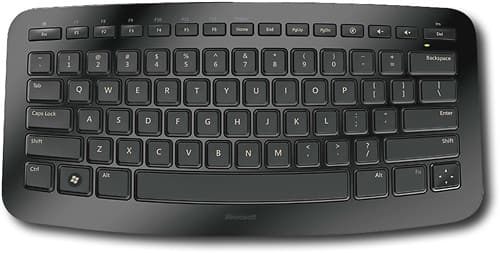
Quick (ha!) review of the Microsoft Arc keyboard

Image stolen from Bestbuy.com, I happened to buy this at a Best Buy, so it's okay?

I'm trying to get myself on a daily writing routine, which has had mixed results so far.  But if I'm going to take this seriously, ergonomics is something I should spend some time researching.  Hell, even if I don't write a lot I spend so much time in front of a computer screen, I should pay a bit more tribute to getting my workspace right.

Concession one was that my screen should be at eye level, a bit of a problem when I'm using a tiny netbook to do most of my writing.  But a wireless keyboard and any sort of box can fix that.  (I also have a second solution which is working nicely in my bedroom, which is to use my television as my primary monitor, using it from across the room.  I have to scale the font size way up, but looking say twenty feet away for extended periods of time is supposed to be easier on the eyes than looking say a foot away for similar amounts of time, so hopefully a screen eight feet away will be a little better as well.  I'm not a doctor, a million doctors may be rolling their eyes at this right now, but it's not like my eyes have fallen out of their sockets or anything as a result either).


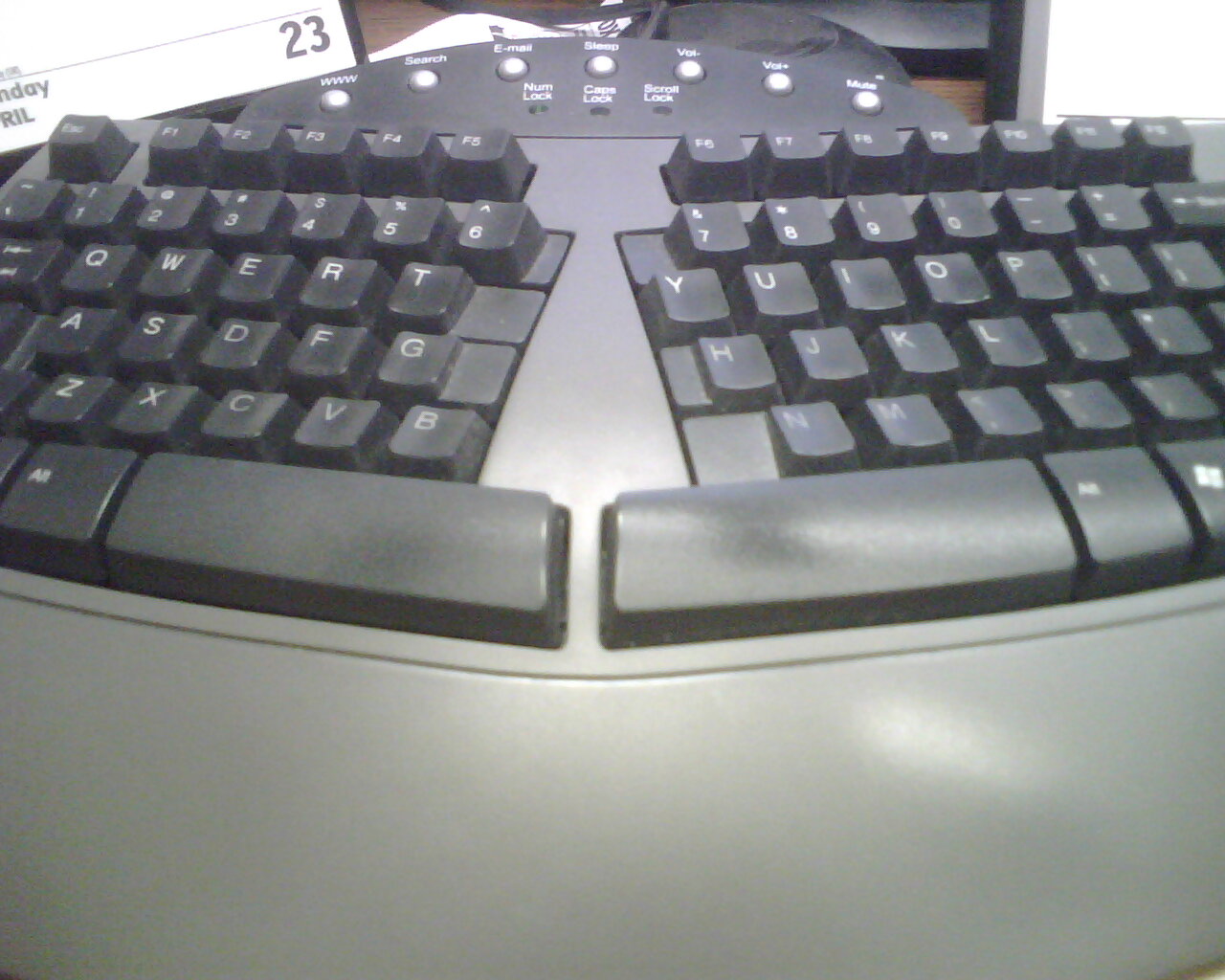
Okay, so I'm buying a keyboard, what keyboard?    I'm not interested in those split super-ergonomic keyboards (see picture above - source).  I've used them a little at work, not a fan.  Honestly I feel like the biggest boon to my hands would be just making a point to type as gently as possible.  Back when I wrote with a pen and paper like some kind of super-advanced caveman with access to advanced processing and mass production facilities, I noticed I wrote as if I thought the harder I clutched the pen the faster I would go.  Not so.  Buying better, smoother pens helped, but ultimately I had to keep reminding myself to go easier on my grip until I rewrote the habit.

Alternatively, I read one article on ergonomics that said just having multiple dissimilar keyboards that you switch between can help a lot.  The type of injuries I'm trying to avoid here are repetitive stress injuries of course, and a bigger, smaller, or differently shaped keyboard could help reduce the repetition.  So, want to know what kind of keyboard I bought?  Spoiler alert, look at the title of this post!

I've been using the Microsoft Arc keyboard for a month now.  Here is a random assortment of thoughts:

  • It's wireless, but not Bluetooth?  The lack of Bluetooth means 1) it uses an extra usb port, 2) I can't use it on my phone or tablet. 3) I'm fucked if I ever lose that dongle.  Does Bluetooth have some engineering problems I'm unaware of?  I'm pretty sure Bluetooth 4.0 makes it way easier to conform to their standards without paying for a license, or is that only for hobbyists?
  • Bluetooth does have one downside for say streaming music as many devices don't have a dedicated Bluetooth chip, so using Bluetooth slows your wifi a bit, and using wifi can degrade your Bluetooth signal.  That said, I doubt it applies too much to a keyboard, and even in music streaming it's a minor annoyance at best, I can always plug into a speaker's aux port if the data exchange is too vexing.
  • Looking at the box, I just noticed it says that it works on Xbox too!  Does that mean their refusal to use Bluetooth on the Xbox is why this keyboard isn't Bluetooth?  If so, way to steer into a poor decision.
  • It is not backlit, and the letters on the keys are off-white with a dull matte finish.  Why?  Why doesn't this shit ever end?  And why me???  But seriously, why not use bright reflective white (yellow is better but might be annoying to some) letter decals out of the factory?  Understand, I'm a touch-typist, largely.  But I do look at the keyboard occasionally, and lower contrast keys make my mind pause for a second to discern my hand's proper position, even if my hands already know where they are.  It's weird, but that's how it is.  Even if they're not reflective, why in Great Scott's name are they dull grey?  In the dimly lit room I'm typing in now it's really a bit of a strain to make them out. (I'm serious, not only is it a bit of a strain, it's really a bit.  Not metaphorically, but really.  A bit of a strain.  So you know I'm drawing some lines in the mothereffing sand here).
  • There are no separate directional keys, which I didn't notice at the time of purchase (I was more worried about the location of the CTRL key, which is in the right place, btw).  There is a single four-way rocker key that acts as all four arrow keys.  It's not as nice as dedicated keys, but it works, and smaller keyboards all make some sort of compromise to get all the keys we know and expect to fit in a uniform rectangle.
  • There are also only six dedicated F-keys (F1-F6), the rest of the top row are Home, End, Page Up, Page Down, volume keys and Delete.  You can use the Fn key to call up F7-F12 if you must. It doesn't affect my use in the slightest, F2 and F5 are the only two F-keys I really use.
  • I don't know if the curved shape is easier on my hands or anything.  I did notice I've been able to type quickly on it from the get go.  And it is different from my other keyboards without being prohibitively so, so I think it fits the bill.
  • All the keys cut off at a certain point if held down for too long.  The arrow keys have about 159 "key sends" (according to my text editor) before cutting off and something like 129 sends for a random letter I just held down to test.  I'm assuming they did some research and found the curved surface makes accidental presses more likely if you set the keyboard aside for a moment, or happen to set something like a magazine on it (on a flat keyboard the weight would be distributed equally over most of the keys, on this one some keys are naturally higher than the others).  Doesn't matter too much, except the arrow keys cutting out are really annoying if you're trying to select a long bit of text, for example.  Not a deal-breaker, but a minor annoyance.
  • No adjustable angle.  I know, most adjustable height tabs on keyboards are plastic and break really easily, they're mostly crap anyway and never seem to give enough angle.  But being a human, I need to feel like I have at least a little bit of control over my environment, you know?


Above is a picture of my keyboard. I applied some reflective yellow stickers to increase the visibility of the keys.  Note that this picture is taken with a flash, but it does highlight the difference between the stickers and the dull matte original labeling (which you can see on the top and bottom right corners of the keyboard).  The original decals look okay in this picture, but consider the flash and the contrast ratio between the decal types.  Imagine using this in low light. I wish manufacturers would realize that they don't even have to ship backlit keyboards, just make the key decals bright and reflective enough to be illuminated by a dim monitor.  They really do make a difference.

I like the action, the keys are fairly quiet but springy.  I might like a bit less resistance but that's probably because I'm more used to flimsy laptop keyboards. My real problem is the lack of Bluetooth---it means this device will stay at home when I travel, and a cheaper, backlit bluetooth keyboard will go with me, so I can break it out to continue work on my tablet if and when my laptop dies.  A backlit bluetooth version of this keyboard would make me a rabid evangelist in spite of all other flaws, because the design and feel of this keyboard really is quite good.

By the way, another tip I saw on saving your hands if you type a lot, don't hit two keys with one hand. Yeah.  So when you do CTRL+ something or SHIFT+something have one hand hit the Control or Shift keys and have your other do the other key, as I just didn't when typing them in caps.  It's a hard habit to get into, because using the shift key is usually so fast I don't think about it until half a sentence later.  Also, remember in your school's typing class how cool it was when you realized how many keys you could hit with one hand, or how far apart two keys could be and still be hit with one hand?  Well I do, and apparently that was me flipping off the future.  Conform to mediocrity, as I should have done!  Conform!  Also never do CTRL+ALT+DELETE unless you put a glass or something on the delete key, and don't spill your drink on the keyboard either.  And don't sue me if you do.  Also don't sue me if ergonomics ends up being less of a science than homeopathy.

Well heavens, my initiative to write more is working, look at all these words!  Can you feel the power?  Let me just make a note of this progress...  Oh, it seems that on my list of activities, blog posts are considered to be borderline stalling and don't necessarily count as "productive behavior". Well isn't that just the shits?   I blame you, Microsoft!  And Google, you know what you've done!

Ok, I guess it's back to stalling in other online spaces.

-David

Friday, July 10, 2015

The more things change...

So I think I wrote an article a while ago about using a Raspberry Pi 2 as a media streamer, and a Banana Pi as a file server.  It worked for a while, with a Chromecast handing cloud streaming and my Pi 2 handling LAN streaming.  But I returned home from an extended vacation wanting to copy all the music and comics I'd bought onto my backup drive that's connected to the Banana Pi, but it was out of commission.  I restarted it, and it froze.  I reloaded a new image, and after a few minutes it froze.  I tried a new card, a new adapter, I checked the md5 hash of the image, all was as it should have been.  It still froze every time after a few minutes.

Did a power spike damage it?  Is the power source petering out?  I should maybe have tried a different image file than Lubuntu too, (I prefer Lubuntu.  It's reasonably lightweight, and it ships with all the Windows shortcuts enabled by default---home key + e =   file manager, home + d = show desktop, etc.  When you get down to it I'm a man of simple yet specific tastes.) but after a certain point I'd put more time into it than I cared to and I wasn't going to try anything more.  I did also Google and couldn't find any complaints about that particular image (obtained directly from the manufacturer's website) being faulty.

I turned on my old laptop.  It's still working, still running Lubuntu, and I plugged in the new drive I'd bought to run off the Banana Pi.  The permissions were still good, Samba is really easy to set up new shares with, there have been no problems.  File transfer speeds are about the same as they were on the Pi, which honestly are still pretty underwhelming, averaging out at like 10 MB/s.

It uses a little more energy than the Pi (it is a pretty small laptop though), but I guess it's what I've been reduced to.  Some weekend I'll try a little more troubleshooting with the Banana Pi and see what's up.

Switching back to my laptop does add some more features though.  For one, Dropbox has builds for Linux but no for ARM processors (even though they have a fairly underwhelming app for Android ARM which doesn't do constant two-way sync).  So it's an easy thing to sync my Dropbox and do daily encrypted backups, and then upload those backups to Google Drive or something, just as another backup*.

Anyway, just felt like throwing up a quick update.

-David

* I have 1TB storage free for probably another year or so on Google Drive but I won't use in place of Dropbox because its sync protocols are abhorrent, and seem to have been designed to discourage persistent syncing across multiple devices.  I suspect they want to get people in the habit of only storing their files on Google's cloud, and forgoing local copies.  Even with 1 Gbps Fiber internet that wouldn't sound more convenient or safer to me.  But then again, I live in an imperfect world where when the power goes out, the internet goes out too and I'm left at the mercy of my laptop's battery and what files I've got stored locally.  More evidence of Drive edging people towards cloud only is that the Google Nexus devices don't have microSD slots, as far as I've noticed.

It's also worth noting that the only reason my backups would be encrypted would be to keep Google from mining it all for more data.  In principal I understand how it could benefit me as a consumer to see more ads that apply to my life (and less ads that merely waste my time), but that doesn't mean I won't prefer other options that aren't so voyeuristic, even if I have to pay for them.  Such an ad system could be similarly effective by using things I consciously and willingly disclose, as opposed to their crawlers getting their feet in the door early and just setting their minds to desensitizing people to the creepiness of it all.  But then again, if I give that demographic info away willingly, how can Google and Facebook make money selling it?

Monday, May 25, 2015

Daala and H.264

This is an article I've been thinking over for a while, and was sort of forced to write it when I saw the ideas within were taking over another article I was writing about Mozilla and Firefox OS.  So I'll write this here and (hopefully) finish the Mozilla post afterwards.

So, x.264 sucks.  Don't get me wrong, it's a decent codec.  But it's also a bit of a honey pot, one that doesn't directly cost you and me, but it costs device and software manufacturers, so does cost us indirectly in the long run.

While Apple and Google were lining up behind h.264, I think people (myself included) were blinded by its being an "open" video standard.  I presumed that to mean license free.  What it really means is anybody can create their own decoder, but you still have to pay a license to provide that or any decoder.  That's right, it doesn't matter if libx264 is open source, it still costs you if you want to ship it on a device or use it to create a web-based player.  Mp3 decoding requires a similar license fee.  This is a contributing factor to Microsoft discontinuing Windows Media Player.  It also means I was a bit hard on Archos back in the day for charging for extra codec packs.  They might have made some money off them, but they were at least slightly justified in making them optional.

The insidiousness is this:  h.264 is a decent codec, and free for most of us to use.  So of course if we rip video, or edit home movies, we would probably save them in h.264.  I would bet most home video files and torrent files are h.264.  Blu-Ray video is also h.264, by the way.  So the trick is, by making it free to users, they've helped to ensure that h.264 is what people will use.  Therefore, anybody who wants to create an audio/video platform (be it a game console, phone, web site, set top box) would have to support h.264, and therefore would have to pay money to MPEG LE, LLC in license fees.  (you could argue that you could have your web platform use whatever codecs you want, but then you'd lose CPU power, both because CPUs are commonly optimized for h.264 decoding, and because most source videos would be h.264, so you'd have to decode them anyway.)

And if you think about it, you can see why Apple and Google were all for it.  Google has more than enough money to toss out to pay up for a license for Youtube, same with Apple and iTunes.  But it also creates a nice little barrier for entry, preventing other similar sites from popping up and competing.  I'm not sure how much it costs, or if it's by video or a yearly fee or what.  It may in fact only be a nuisance fee that doesn't block anybody.  (actually, there's a price breakdown here, it looks like an annual cost, around 14 cents a subscriber at one tier)

Most Linux distros don't include any non-free software in their official repos.  As you can gather, it's not due to snobbery.  It's because if they shipped non-free products like these decoders with their software they'd have to pay licence fees.  It may be just slightly because of the most well-meaning snobbery, but mostly it's because of legal reasons, I'm sure.

The Xiph Foundation, the organization behind Ogg Vorbis and Opus, are now working on Daala (with Mozilla's help).  Daala is the answer to h.264 and h.265---it's not finished yet (it'll probably take another year or so) but it already outperforms both of the aforementioned MPEG codecs.  I should say though that by the graph in the video linked below it seems to only marginally outperform both.  Don't expect magic, just be happy that this thing which is completely free is also superior to what others want you to pay for.

If you're interested in Daala, check out this video by Timothy Terriberry, explaining the choices they made in creating the video codec.  It's an hour long but fascinating.  My favorite part, his description of a invertible blocking filter.  They can block up the video to make it easier to process, encode it, and then have the decoder deblock the video (inverting the previous blocking filter), preserving a lot of the information at a reduced CPU cost.

Another funny bit in the video, Mr. Terriberry explains that one of the ways to avoid patent infringement was to find something all other video codecs do,  and simply not do that thing.  There are four areas in which they deviated from the norm.  One of them, Displaced Frame Difference, is so common that their technical writer inserted it into an early draft of their patent application on his own, assuming that since it's a video codec, it must use DFD.

One last note, the x.264 and lame mp3 encoders are both open source, and both considered by many to be the top of their fields.  x.264 especially is thought to be the best optimized h.264 encoder out there.  I can only imagine when Daala comes out, and these communities start optimizing it, I can't wait to see what happens.

Til then,

David

Friday, March 13, 2015

Yik Yik, UR, and how I would reply...

Been going through my rss feeds and saw this article on TechDirt. Basically some University of Rochester (NY) students are posting offensive things on Yik Yak.  UR's senior legal council (Crummins) has sent Yik Yak a letter demanding they remove all offensive posts (in perpetuity) and deactivate the accounts of anyone who posts anything offensive. They also ask to be provided with:

Any information in Yik Yak’s possession or control, including but not limited to names, email addresses, IP addresses, phone identifiers or other information that would help the university identify those users.

As TechDirt reports:

Yik Yak’s FAQ indicates that it won’t be doing anything Crummins has requested. It responds – like most online services – only to actual legal documents like court orders, subpoenas and warrants

Which is good, but I’d do them one better. If I were them I’d email Crummins back and say:

Dear Sir:

We would like to inform you that we have taken your concerns and instructions to heart. As such, because we find your email so offensive we are deleting it immediately after sending this reply. Furthermore, we will be sending your IT department and your ISP demands that they de-activate your email account as to prevent you from offending anybody else.

Good day

It probably wouldn’t even make him think twice, but it might make them feel better.

David

Oops

I was going to write a quick reaction post on my phone, but forgot how shitty the Blogger app for Android is.  No blockquote?  Doesn't Google realize that 90% of blogging nowadays is quoting other posts?

Srsly Googs, get with it.

David

>Just in case, testing Markdown blockquote functionality.

Did it work?

Thursday, March 12, 2015

Abstract Studios now DRM-free on Comixology

Now I know that Strangers in Paradise wasn't DRM-free on Comixology a while ago.  I'd checked it specifically.  Well now all of Abstract Studios' (ie Terry Moore's) comics are now DRM-free.  Strangers in Paradise, SIP Kids, Echo and Rachel Rising.  Which means my bank account will be getting significantly lighter over the next month or so.

Torn on whether or not to start Rachel Rising, because I strongly dislike reading ongoing comics, I'm absolutely a binge consumer.  On the other hand, I've heard good things, I'd like to support it, etc.  I'll probably start reading it soon.

David

PS I've still got no clue what's going on with Dynamite's catalog.  Comics that were DRM-free on their second Humble Comic Bundle sale aren't DRM-free on Comixology.  They are slowly expanding their DRM-free titles - most of The Boys is now DRM-free.  What's going on, how did IDW (and many others) convert their catalog over so much faster than Dynamite?

Also can we start a letter writing campaign to Boom Studios asking them their stance and plans regarding DRM?  They had a DRM-free Humble Comic Bundle as well but aren't participating in Comixology's DRM-free option.  I sent them an email about it ages ago and never heard back. Hmmph.

Wednesday, March 4, 2015

Server/Streamer Dillemma Resolved

Well, I worked it out.  I did end up buying a Pi2 and a Banana Pi.  The Lubuntu image fort he BPi worked great, looks great, and I set up a Samba share with no problem.  The Raspberry Pi was a little more difficult, though to be fair it needed sound over HDMI to be setup, the BPi has no use for sound so I didn't even test it.

I tried a few different distros but couldn't (and still can't) get sound working across all applications on the Pi.  Mplayer won't play sound, VLC will but won't play video.  Some audio players worked, some didn't.  I tried all the tricks: uninstalling Pulse, forcing audio through HDMI instead of the headphone jack, etc.  No dice.

Ultimately I tried OMXPlayer, which is pretty cool.  I wish the timeline seeking were a little more fine-grained but it's fine.  The playback is really smooth and it looks great, better than any other player I got running.  OMXPlayer was written for the Pi (I think) and it shows.  The only issue is OMXPlayer is command-line only, so I added a desktop entry for OMXPlayer so it would play the file with a double-click, no typing required.  The desktop entry I used was copied from this thread.

Other hitches not unique to the Pi:  I forget over and over how big of a dick Ubuntu can be with external drives.  If it's a thumb drive or SD card it usually allows any user to write to it, but a large hard drive is locked down and only root can write to it.  Chmod and Chown don't work as they should, and strange workarounds always seem to be needed.  This was my experience when setting up my old laptop as a file server too.

Also, Linux audio still seems to be where MS-DOS was at its height.  I didn't have to mess with channels or IRQs or whatever but I might as well have.  Not to mention the confusing overlap of interfaces.  Do ALSA and Pulseaudio do the same things?  Pulseaudio is the newer one and was supposed to replace ALSA, yeah?  I don't really know, I seem to remember it being explained like that to me at one time.  Audio and wifi were always the biggest issues for me to get working with Linux a decade ago (and video acceleration, but in that case if you didn't have it you probably never would so no tweaking was needed either way).  I still remember the days when updating Ubuntu meant keeping my fingers crossed because wifi and audio were very likely to have been broken in the process.

And don't get me started on the problem of new versions of certain programs (or even the system itself) keeping old config files in their old directories but ignoring them, and you're supposed to know this somehow and seek out the new place to create or edit an identical config---once you realize the program has stopped working right, of course.  Some programs have three or four copies of the same config file scattered around and it's a fun game of elimination seeing which file actually affects the program's behavior.

Wait, was I ranting on Linux or was I talking about my home media setup?  Anyway, it works well, I'm very pleased.  The Banana Pi isn't set up for transcoding, not that I think it could do anything heavy anyway, but with the Raspberry Pi I don't think I'll need any.  It does worry me that I only have one working video player on the Pi, in my experience every video player has a few files it just can't play properly even though every other player can.  Still, I think I'll be fine.

Now to start copying all the videos on my watch list over to my network drive.

David

Monday, March 2, 2015

OMG The Plot Thickens

As I said in a recent post, I've recently gotten a Chromecast.  It's okay, except or the part where it doesn't support mkv and kind of made me re-evaluate my current home server setup.  Hey, I thought, why don't I replace my file server with a Raspberry PI that's plugged into my tv, that also has a samba share.  I can drag files over to the PI's network folder to play them on my tv.  Of course it would work, why wouldn't it?

Oh David, you simple fool.  Here's why. Benchmark tests of the Raspberry Pi B+, the Pi 2 B, and a Banana Pi.  The BPi has a gigabit ethernet port and a Sata hard drive port for much faster speeds.  However, even a USB drive on the BPi was seeing twice the transfer speeds over a network then the Pi 2.  So its settled, right?  Buy a BPi, set up a file server, plug it inso my tv and play media off the network folder it hosts.

Hahahahaha, nice try though!
The Banana Pi and Banana Pro do not have proper hardware acceleration because of the Mali GPU chipset’s lack of documentation so it is unknown if its full graphics potential will ever be unlocked for media center tasks.
Wah-wah.  So where does that leave us?  A few people chime in to say that the Banana Pi is good for media serving, and the Raspberry Pi 2 is good for media streaming.  In other words, the BPi is a good file host, and the Pi2 is a good player.

It occurs to me that it's not too ridiculous to do this setup:

-BPi with external hard drive attached, plugged directly into my router.  Network share all set up.
-Pi2 set up and plugged into television, streaming media off of the BPi.

Seems a bit ridiculous, like overkill, but look at it this way:  My Alienware uses 10-27 Watts, depending on what it's doing.  A Pi2 and a BPi would use around 4 watts apiece (depending on what you're doing and what's plugged in).  So 8 watts, that's still a large drop in power consumption  Ordered online they'd both be about $40 with shipping and everything.  I already have HDMI cables and 2 amp USB chargers and all that.  So $80 to have a small, quiet and efficient media server/media streamer?

I'm thinking about it.  I am.

David

Brief (HA!) Aside - why Pi over laptop

So as I was writing that last article I realized I kind of gravitated to the Pi even though my laptop, an existing device, could already do everything I needed.  I thought it over and here's why I may buy a Raspberry Pi 2 B to use as a set top media box and file server:

  1. Low power usage.  The power savings of using my laptop over a desktop are huge.  Using a Pi over my laptop would probably be a similar order of power savings.
  2. My laptop has a fan, it runs a lot, it makes noise.  Not a big deal, but something to consider.
  3. The Pi has better support. My laptop is an Alienware M11x, a great computer for gaming on at the time because there ware a ton of other enthusiasts with an identical device trying to wring out as many frames per second as possible, I could crib their settings and save myself the hours of testing.  Unfortunately the Linux support isn't to great.  A lot of people run Linux on it, but I don't see anyone having HDMI audio working on my model, the resolution is kind of borked, I have to disable the laptop's screen to get full screen video to play right on my tv.  The Raspberry Pi has an army of people doing al sorts of cool things, it's very well supported, there are a ton of custom images for it.  
  4. Smaller package.  The Pi takes up less space.  It should fit nicely under my TV, actually between the screen itself and the stand.  Of course then I plug a big bulky HDD into it, but that's another issue entirely.

Given the price it seems win-win.  I'm going to do some research on its file serving reliability before I make any decisions though.

Til then,

David